“What is a fillet, and what is a chamfer?” You have probably heard this question thousands of times, especially if you’re into design engineering. Most people tend to mix up these two phenomena when they are the opposite of each other.
Knowing the difference between these two phenomena is one essential factor designers must consider. This is because the choice made will be a determinant of the part manufacturer’s success or failure as the choice made will determine factors like the stress flow and concentration.
This article will explain everything you need to know about the concept of fillet and chamfer. Also, you’ll learn their common differences, when you need them, and how to decide which to use.
What is a Fillet?
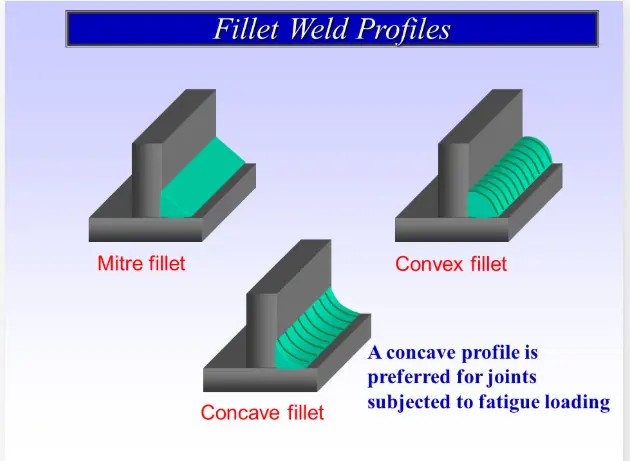
In mechanical engineering, machinists refer to a fillet as the round parts of designs either on the interior or exterior of edges.
There are three types of fillet mechanics: miter, concave, and convex fillets. On the interior side, fillets are concave, while on the exterior, they are convex. Engineers use fillets to reduce the stress on a part. Hence, the fillet helps distribute stress on a larger surface, preventing the stressed part from rapid deformation.
When the design requires eliminating sharp edges and low stress concentration, fillet engineering is the best option for machinists to utilize
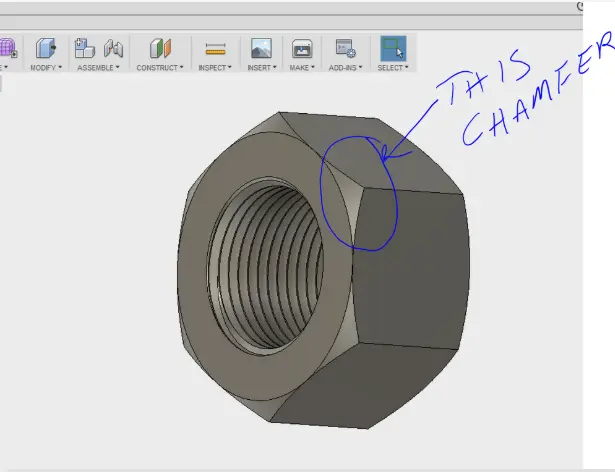
A chamfer is the sloped or angled edges or corners of a part design. It is an antonym of the fillet. Instead of having a curved shape, a chamfer is straight and has a sharp angle. Machinists use chamfers for parts that require high-stress concentration edges. It focuses the stress in a specific part of the design, and if used for designs where low-stress concentration is needed, such material can easily deform.
A chamfer is also applied to both the interior and exterior of a design. There are circumstances where it is preferred to fillet. It is usually at an angle of 45 degrees to a horizontal, and it helps to bevel the edge of a hole after the drilling operation. If your design involves making a part for driving screws and you don’t want the head of the screw to stick out, a chamfer is what you need. It will make the edge of the screw sit comfortably below the surface, which might not be possible should you use a fillet.
There are also larger chamfers, usually 60 degrees, that machinists use as a lead-in for bolts or screws. If your design requires sharp corners to be efficient for its purpose, you should choose chamfer over the different fillet mechanics.
When Do You Need a Fillet or Chamfer?
Apart from differentiating between both, machinists encounter a problem choosing the right one for their design. Often, using the wrong one can increase manufacturing costs and reduce the efficiency of the parts.
The part may also not last long enough if chamfer is used in place of fillet and vice versa. Hence, it is important to understand the fillet and chamfer concepts to know which one is right for your design. Now, let’s break this down and discuss in detail when to use fillet and chamfer.
Edges of the part
To avoid accidents during handling and inspection, it is safer to break all edges of your parts’ design. However, the chamfer is not always the best option for the edges of parts. The sharp edges might cause injury while handling. Hence, you may want to opt for a fillet in this case.
There are some differences between Fillet and Chamfer that you should know. However, we’ll explain the differences between fillet vs chamfer in a tabular form for a better understanding.
Fillet
Chamfer
Machining cost
More expensive than the chamfer
Cheaper
Machining time
Curved edges aren’t very easy to make and require more patience. Therefore, Fillet engineering takes more time compared to chamfer.
It is faster than fillet.
Cutting tools
You need special cutting tools to make fillets. This is because it has a different radius. Hence, the kind of radius you want to make determines the cutting tools you have to use.
You can use one cutting tool to make different chamfer sizes. Therefore, you don’t need multiple tools for your chamfer design.
Stress concentration
It shares the stress on a larger radius, protecting the part from deforming. It is best for the exterior part.
Stress is concentrated on a part and can cause the material to deform easily.
 Tony Chow
Published Date: 2026/1/12
Tony Chow
Published Date: 2026/1/12