Yes, they are different. Although people can use the processes interchangeably since they are suitable for marking several products, they should not. The major difference between laser etching and engraving lies in what happens to the workpiece.
On the one hand, laser etching uses high heat to melt and raise the workpiece’s surface. This creates the design when the surface cools down. On the other hand, laser engraving vaporizes the workpiece surface cutting a deeper cavity that acts as the design. Other differences between both processes are evident in compatible materials and production volume. All these will be introduced throughout the course of this article.
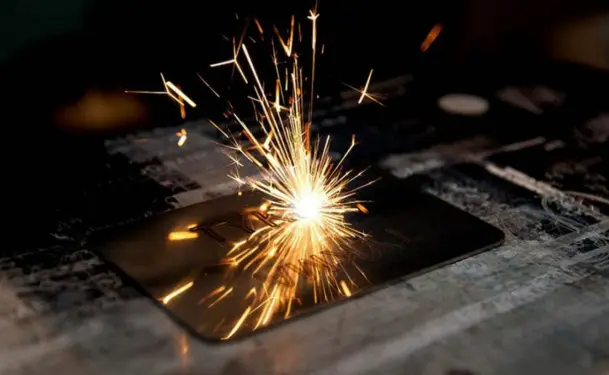
Laser etching is a process that releases a large amount of energy at specific intervals via the laser beam to create a mark on a surface.
In the process, the energy absorbed by the material is converted to heat which melts and expands the workpiece surface at a micro-level. Due to heat absorption, the surface also becomes malleable, localized changes occur, and there is a color change. After expansion, localized changes, and color change, the surface cools down, and the change creates permanent markings.
Metals are the most common materials used with laser etching. Examples include different grades of aluminum, anodized aluminum, stainless steel, and zinc. The method is also compatible with plated, anodized, and bare metal surfaces.
The list of materials compatible with laser etching is non-exhaustive. Other materials include non-metallic materials like glass, polymers, and ceramics. Also, since the material determines the quality of markings, you should get a laser etching expert on what to do.
Advantages of Laser Etching
The process is common in industries such as the medical component industry and the automotive industry. Below are a few reasons why you should consider the process:
- High precision: It is highly accurate and precise because of the laser’s use, making it ideal for marking small details on different products such as jewelry.
- Very quick process: It is highly productive and time-efficient. It is twice as fast as other laser marking techniques. Due to the quick process, it is important for those that want speedy mass production marking or have short deadlines.
- Versatile range of application: It is compatible with various materials such as metals (most common), paper, wood, and acrylics. Hence, its wide application.
- Effective for thick and thin materials: It is compatible with thick and thin materials making it an efficient or versatile metal fabrication process for inscribing fine artistic designs.
- Cost-effective process: It is a highly cost-effective process of consistently manufacturing precision parts. For example, laser marking machines do not take up much power. Therefore, running costs are lower.
Disadvantages of Laser Etching
Although it has its advantages, the process also has its drawbacks. Below are some of its disadvantages:
- Less durable results: Markings made with the process don’t not wear and tear-resistant compared to laser engraved markings. Therefore, they are less durable.
- A fiber laser can only achieve results: Fiber laser marking machines are the only compatible machine for the process. This is because metals, the most common supported materials, can absorb the wavelength of fiber laser markers (1064nm) more than other laser markers. This limitation affects the use of the process by smaller metal fabrication
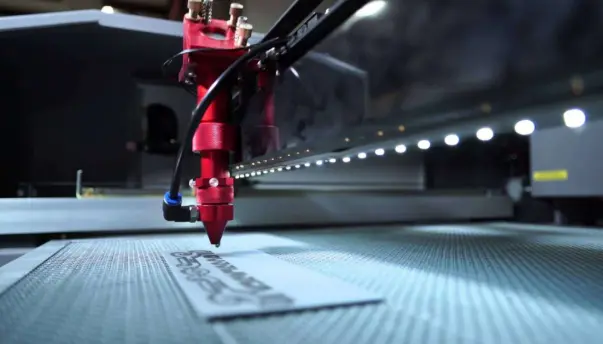
The laser engraving process releases enormous energy acting like a chisel to the workpiece’s surface to create deep and permanent designs. The process is a common method for marking products subject to wear or harsh surface treatments.
Metals are also the most common laser engraved materials, with the commonest being stainless steel. Other metals are brass and titanium. The process is also compatible with other materials such as fiberglass, wood, and paper and uses either fiber or CO2 laser marking machines. Therefore, it is suitable for both metals and organic materials.
Advantages of Laser Engraving
Below are a few reasons why you should consider the process:
- Tactile Markings: Engraved markings are easily discernable by touch and visually. This is because engraving also creates a cavity on the workpiece.
- Wear and Tear Resistant: The engraved markings are resistant to wear and tears compared to the laser-etched surface due to the deeper and invasive cutting action. Hence it is more suitable for products used in harsh conditions.
- Quick and Efficient: The process is also quick and efficient compared to traditional engraving. Therefore, it is highly suitable for mass production.
Disadvantages of Laser Engraving
The process also has its drawbacks. Below are some disadvantages you should take note of:
- Uses More Energy: It requires much energy due to using a higher intensity laser engraving machine. Therefore, there is an increase in cost. The use of energy becomes intense when working with materials such as stainless steel.
- Less Versatile: It is a less versatile method than laser etching due to limitations on the kind of materials compatible with it. For example, it is unsuitable for marking materials used in corrosive conditions as it can hasten the process. This and others are a few limitations in the range of application of the technique.
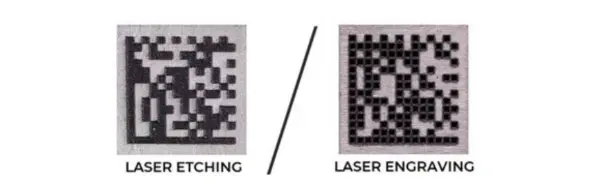
To choose effectively between both methods, you should be able to compare the two methods. Below is a comparison of the difference between etching and engraving.
Laser Etching vs Engraving: Cut Depth
One distinct difference is the cut depth, which plays an important role in the marking’s visibility and wear and tear resistance.
Laser engraving has a deeper cut depth than other laser techniques as it removes more materials. Generally, metals have a cutting depth of 0.020 inches. However, the cut depth depends on the material’s hardness and the power rating of the laser marker. For example, soft materials are more easily cut than harder ones, and they have a maximum engraving depth of 0.125 inches.
Laser etching melts the surface delivering little to no cutting actions. However, the indentation produced can have a cut depth of about 0.001 inches in some cases.
Laser Etching vs Engraving: Production Volume
Engraving is the most cost-effective option for fewer labels, while laser etching is the cost-effective option for higher production volume since it has better versatility.
Laser Etching vs Engraving: Durability
Laser engraved markings are more durable than laser-etched products. It is quick and precise. However, it only melts the material surface with no indentation. Therefore, laser-etched markings do not have good wear and tear resistance compared to engraved markings. Generally, etched markings last for about 5 to 10 years, making them unsuitable for making heavy-duty products or those exposed to harsh conditions.
Laser engraved products are highly durable due to the deeper indentation. They take longer to wear off. The durability also increases when a powerful laser engraving machine is used since it will deliver a deeper marking.
Laser Etching vs Engraving: Cost
Laser engraving costs is higher than that of laser etching because it requires more time and more powerful machine and laser technology. Other factors that affect the costs include:
- Material: Hard materials requires more time and powerful machine, further increasing the cost of markings.
- Design/character size and depth: The more complex the design, the higher the cost of etching or engraving.
- Production volume: The higher the production volume, the lower the price. Therefore, larger production volumes are ideal.
Laser Etching vs Engraving: Applications
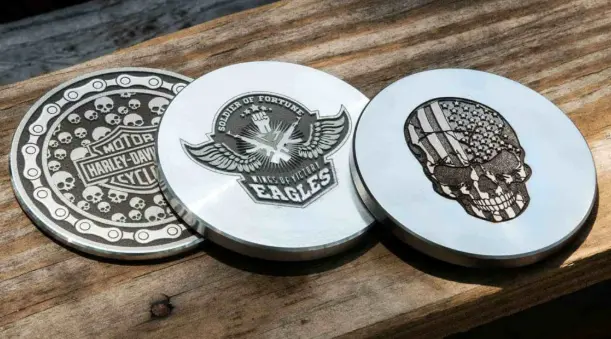
Both processes have similar applications. However, the project’s specifications in terms of durability, easily discernable markings, etc., play an important role in the suitable method. Both methods are suitable for making the following:
- Light commercial purposes: Both methods are important in personalizing artistic and light commercial products—for example, metal card holders, nameplates, metal pens and jewelry.
- Industrial purposes: Both methods are suitable for marking products used in heavy industries such as aerospace, automotive, and transportation. However, you should factor in the markings’ durability for such a process.
The two processes are important since they ensure part traceability. Part traceability involves marking a product with a code or number that reflects the product manufacturer, specs, and other details. It is an important regulation for many industries—for example, medical device and aerospace component manufacturers to increase the safety and reliability of their products.
They provide easy, efficient marking and permanent markings that enable part traceability. Therefore, manufacturers can quickly and easily determine a part-time space and easily make critical recalls and warranty decisions.
Although both processes are similar, they have many bold dissimilarities that affect their applications. Generally, laser etching is more suitable for artistic products that require less durable results, while laser engraving produces a highly durable product.
Require laser marking on your machined parts? RapidDirect provides custom laser etching and engraving services for your needs.
We also provide surface finishing and other manufacturing services such as CNC machining, injection molding, and 3D printing. You can contact us to request a quote today.
 Penny Pan
Published Date: 2026/1/8
Penny Pan
Published Date: 2026/1/8
