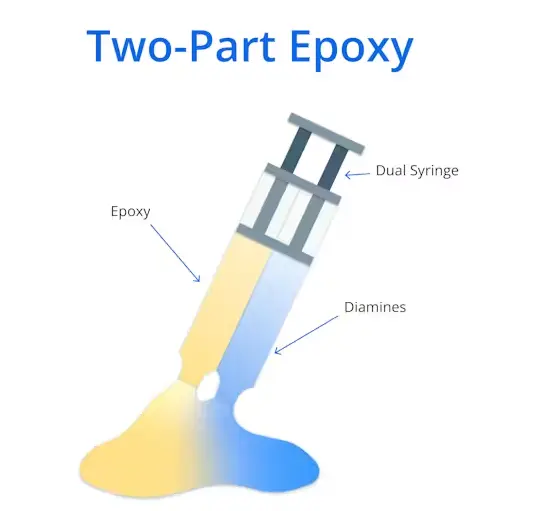
Swiss chemist Pierre Castan can be thanked for creating epoxy resin after experimenting with reactions between several different chemicals. This happened in the 1930s and he was eventually granted a patent in 1940. Around the same time, a German chemist named Paul Schlack was also toying with different materials, leading to the ability we now have to synthesize and manufacture epoxies.
In the 1940s and 1950s, the dental industry started using epoxy and gradually it began gaining traction in other industries, like the aerospace, marine, and automotive sectors. Twenty years later, they entered the consumer market and have since remained an important material for large manufacturers and companies as well as individual hobbyists.
What Are the Properties of Epoxy?
Looks-wise, epoxy morphs from a paste, liquid, or gel into a hardened solid. It’s usually clear or slightly opaque and you can tint it in numerous different colors. Outside of its appearance, it has many mechanical and physical properties that make it a favorite adhesive and coating.
- Epoxy has high tensile, compressive, and impact strength, so it’s ideal for structural uses.
- They have great chemical resistance to a range of acids, bases, solvents, and oils. That means it’s possible to use epoxies to coat the insides of tanks and reaction chambers as they can handle these rough environments.
- They’re also impressively heat resistant, so they’re capable of serving aerospace and electronic needs. Additionally, they work as great electrical insulators, too.
- Epoxy isn’t prone to serious shrinkage after it cures, so you can use it for surfaces and structures that require good dimensional stability and as little distortion and cracking as possible.
- There are several ways you can cure and cause the polymerization reaction, such as UV curing devices, thermal-triggered catalysts, or through moisture curing.
- As an adhesive, they’re capable of sticking a variety of materials together with ease, including wood, metal, plastic, ceramic, stone, and composite. We use epoxies to join together large 3D-printed models that would not be printable as a single piece.
- Aside from their durability in chemical-laden environments, epoxies can handle exposure to UV radiation, moisture, and saltwater too.
What Are the Different Types of Epoxy?
Epoxy not only has many useful properties, but it comes in a long list of different types, which is useful for customizing the epoxy for your intended application.
1. Standard
This is the closest formula to the original epoxy that appeared back in the 1930s. However, they’ve been tweaked and reformulated to have even higher strength and resilience as well as faster curing times. This is a great cost-effective option for a wide range of purposes, such as for repairs and furniture making.
2. Water-Dispersed (or Water-Based)
This type of epoxy isn’t truly water-based as it’s often called, but it has a water-dispersed composition that will evaporate when it’s cured. It’s a smart formulation to use when you’re sealing tanks or in need of a waterproof sealing agent. They also have low to no volatile organic compounds, which makes them a safe choice when you’re applying them in enclosed environments around people.
3. UV-Cured
As the name implies, this type of epoxy is cured through a UV light and is a two-part process. The epoxy and the chemical that will initiate the reaction are both applied and then hardened through UV. You’ll commonly see this in casting, artwork, and even dental work. Because the epoxy can be irritating or relatively toxic, it takes a well-trained professional to apply it. UV-sensitive epoxy resins are also common in the material used for certain additive manufacturing processes that we offer.
4. Structural
Structural epoxies are perfect for applications that require bonding difficult materials or items or structures that will need to be machined after. This type of epoxy doesn’t slump and it’s pretty viscous, so it’s well suited for filling in gaps and serving as an electrical insulator. They’re also resistant to abrasion, water, and impact, making them an all-out great choice.
5. High-Temperature
For applications where you’ll be subjecting surfaces, structures, or objects to extremely high temperatures, this is the best-suited epoxy for the job. They have very similar properties to other epoxy resins but can withstand temperatures up to 300° C and have good chemical resistance too. They’re typically made with a bisphenol F diglycidyl ether copolymer that gets cured through a fatty acid or tetraethylenepentamine polyamide.
6. Flexible
Within the makeup of flexible epoxies are rubber or elastomer beads that give extra shock tolerance, toughness, and flexibility to the final hardened product. There have been important breakthroughs recently with this type, thanks to the silane and siloxane components within the epoxy. Mixed into the formula, they provide a cross-linked material that’s tough when cured but still ranks as a 20D on the Shore Hardness scale, which is softer than a rubber heel of a shoe.
7. Conductive
A conductive epoxy helps support electrically conductive environments (though they aren’t intrinsically conductive), while also offering surfaces or sections of parts an anti-static, flexible, and durable coating or composite. You’ll find them in repair pastes for etched copper tracks, wristbands on fitness tracking equipment, and circuit boards.
What Are the Different Classes of Epoxy Resin?
On top of epoxy types, there are also specific classes that speak to the chemical groups that make up each type, which we break down below.
1. Glycidyl
This class of epoxies has a functional glycidyl group within their chemical structure, and the resins form through the reaction between epichlorohydrin and a reactive hydrogen compound, like bisphenol A (BPA). From it, you get an epoxy with a linear and branched makeup that has great thermal and chemical resistance and top-notch adhesion. Manufacturers and companies looking for quality adhesives and coatings or an epoxy that works on electronics products or composite materials will likely opt for one of these epoxies.
2. Novolac
This epoxy involves the chemical reaction between phenolic novolac and epichlorohydrin. In comparison to a glycidyl epoxy, or one with BPA in its structure, it offers more chemical resistance and thermal stability thanks to its highly cross-linked structure. This epoxy is usually cured with amines and often has toxic substances in its makeup (like formaldehyde and phenol), so they should be used carefully and in the right environments.
3. Cycloaliphatic
The chemical structure of these epoxies features a ring-like structure as their backbone, making them more rigid and compact. They’re often found in the manufacturing of composites, coatings, and adhesives and usually contain hazardous substances, so it’s best to take care when you’re working with this type. They’re reliable for instances where chemical resistance, mechanical strength, and electrical insulation are important.
4. Aliphatic
Similar sounding to cycloaliphatic epoxies, these differ in that they don’t have a circular structure within their makeup, but a straight or branched set of carbon chains instead. This makes them less rigid than their cyclo-counterparts, lending themselves to situations where flexibility is key. These epoxies are also very useful if you’re after UV resistance, color stability, and low toxicity. That’s why they’re often found in marine, automotive, outdoor, and food applications.
5. Aromatic
An aromatic epoxy also features a “ring” within its chemical structure and is a product of BPA and epichlorohydrin reacting together. They’re great epoxies for lining containers and tanks as they have high levels of chemical resistance and are strong and stiff. They’re relatively glossy as a finish but they’re not ideal for applications that need to retain their color. It’s another class of epoxies that should be used with caution as they contain hazardous substances, too.
6. Hybrid
This class includes epoxies that mix two or more types. As an example, this could be a blend of a cycloaliphatic epoxy with a novolac epoxy. Hybrid epoxies are created and used when you need specific benefits that only occur when you combine several together, and it leads to a material that can be used as a coating, adhesive, or composite in industries that require a higher level of performance, like the aerospace, construction, or automotive sectors.
How To Use an Epoxy?
- Make sure you properly clean and dry any surface that you’re applying epoxy so contaminants, dust, and grime aren’t trapped within it, and so the surface dries evenly.
- Closely follow the mixing ratio when you’re working with an epoxy that requires two different components.
- Apply epoxy evenly and quickly after readying it to avoid problems like uneven surfaces, air pockets, or poor coverage.
- Give the epoxy plenty of time to cure and ensure you stick to the recommended drying times and environment conditions (like specific temperatures). Sometimes it’s a good idea to “overcure” UV cured epoxy to ensure all parts of it have properly set.
How To Choose an Epoxy?
There are a few important considerations to keep in mind when you’re selecting an epoxy. The most important priority is choosing a type or class that’s fit for the application you have in mind. It should be formulated for adhesion, coating, or creating a composite material. Epoxies are also made for specific materials, which ensures that it’ll create a secure and durable bond for that specific surface. There are also a range of cure times, which may be important to note depending on the timeframe or outlying factors that can affect a successful epoxy coating.
In harsh environments or those exposed to high temperatures, choose an epoxy that’s built to handle these factors for the best results. Epoxies can also lead to health problems and hazards (like fires), so check warning labels, find the right environment conditions, and wear the right safety equipment.
 Kim
Published Date: 2026/1/7
Kim
Published Date: 2026/1/7