Plastic: Definition, Types, Properties, Applications, Advantages, and Disadvantages
Plastic is a synthetic material used in a wide variety of applications. Learn more about it here.
 Kim
Published Date: 2025/12/4
Kim
Published Date: 2025/12/4

Plastic is a synthetic material used in a wide variety of applications. Learn more about it here.
Kim
Published Date: 2025/12/4
Plastic is a synthetic or semi-synthetic material that usually comes from petrochemicals or things like cellulose and starch. Certain types of plastic are known as resins. To make plastic, the main components are chemically treated until they make polymers, which are basically long chains of molecules. These can be molded using popular methods like extrusion or injection molding.
Plastic requires lots of different polymers and materials, both artificial and natural. It’s made using several raw materials, and some of them include natural gas, coal, starch, cellulose, crude oil, and even salt. You can make plastic in one of two ways: polymerization or polycondensation.
Plastic is pretty much everywhere today, and that’s because it has many qualities that manufacturers, many of our customers included, really value—like durability, low cost, and ease of production. That goes for both thermoplastics and thermosets, the two main categories. One of the main differences between the two is that the former can be remolded after it’s been melted, but the latter can’t be reworked again when heated.
Plastic is huge among Fsproto customers and is used in toys, electronics, automotive, packaging, and medical devices. It continues to be popular, mainly because it has characteristics that are still hard to find in other materials, like being lightweight, flexible, non-conductive, and not requiring a ton of energy to make. For medical devices, plastics are sterile and biocompatible while easy to mold.
The discovery of plastic dates back to 1839, when Charles Goodyear discovered a way to make rubber more resilient and elastic via a process called vulcanization. During this time, he also made one of the first-ever polymer mixtures. Then, in 1855, Alexander Parkes discovered celluloid, which is a combination of camphor/lime and cellulose nitrate and is also known as Parkesine.
Celluloid was the first thermoplastic that would become flexible when heated and hard again when cooled down. After this, there were several advancements in the world of plastics, such as Victor Regnault’s isolation of PVC in 1835, the creation of the first synthetic polymer (industrial plastic) by John Wesley Hyatt in 1869, and Edward Brandenberger’s introduction of transparent food packaging in 1900.
Many polymers, both artificial and natural, are used to make plastics. Coal, natural gas, cellulose, starch, crude oil, and salt are a few of the most common constituents in the production of plastic. The polymerization and polycondensation processes, which both require specific catalysts, are the main methods for producing plastics. In a polymerization reaction, monomers such as propylene and ethylene are joined to form long polymer chains. Each polymer has a distinct size, structure, and set of properties that depend on the different basic monomers involved.
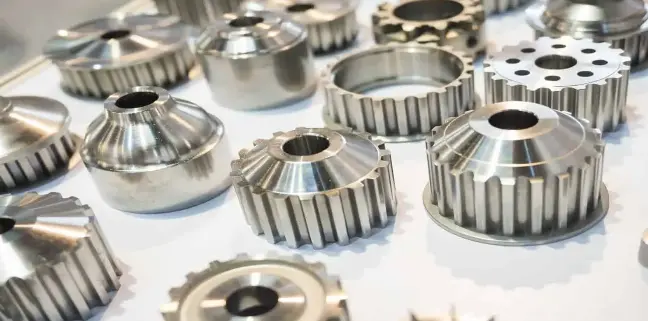
Plastic is extremely versatile, and that’s why so many manufacturers around the world prefer it to other materials. It’s available in lots of colors and textures, and it can be molded into almost any shape you want. Unlike many other materials, it can also be made transparent, like the plastic used in disposable water bottles. As far as textures go, plastic is available in almost any variation, from smooth and shiny to rough and matte. And some can even be flexible. The image below shows a custom plastic part we made at Fsproto using injection molding:
Plastic, or resin, is nearly colorless or milky-white and can be colored by adding colorants or pigments.
Plastic can come in many different colors and textures, depending on the type of plastic and how it has been treated or processed. Plastic is a synthetic polymer made from various organic materials that can be molded into almost any shape. Some types of plastic are clear and transparent, like that used in disposable water bottles, while others are opaque and available in a range of colors. Plastic can also have different surface textures, ranging from smooth and shiny to rough and matte. Some types of plastic have soft and flexible textures, while others are rigid.
There are lots of different types of plastic available today, most of which we offer at Fsproto. We’ve listed some of these below:
This is the most popular thermoplastic resin in the polyester group and is the most produced synthetic plastic. Some of the reasons PET has hit first place are because it’s easy to recycle, resistant to water and organic compounds, has a high strength-to-weight ratio, and is almost shatterproof. That’s why it’s found almost everywhere from food containers to garment fibers.
ABS is also very popular and is made by polymerizing styrene and acrylonitrile with polybutadiene. Many of our customers like ABS because it’s flexible, easy to work with, strong, and resistant to impact. Because it’s relatively inexpensive, ABS can often be found in various items within the automotive and refrigeration industries, as well as protective headgear, luggage, and children’s toys. We have a whole guide on ABS if you’d like to find out more. The following image shows some ABS parts that were 3D printed here at Fsproto: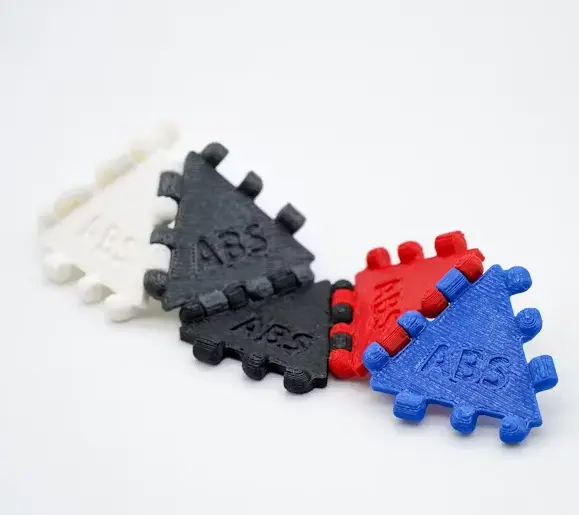
PVC is the third most common synthetic plastic polymer, and it’s available in both flexible and rigid variations, making it really versatile. Foamed PVC sheets, for instance, are often found in in-store displays, exhibits, and kiosks, and you’ll see rigid PVC everywhere, too, from construction materials to windows, to bottles, to non-food packaging. More flexible and softer versions of PVC can actually be found in clothing, as well as plumbing supplies, and medical tubing because of added phthalates and other plasticizers. The following image shows an example of PVC:
Polypropylene is the second most produced synthetic plastic and classifies as a thermoplastic polymer. It’s a hit among Fsproto customers largely because of how flexible it is. Despite that, it still manages to be surprisingly strong. That’s why PP sheets are used for things like food containers, medical devices, automobile components, and laboratory equipment. It also helps that they’re affordable and resistant to heat and acid.
Now we move to the most common plastic on the planet; polyethylene (PE). This material comes in several densities, and you can see a breakdown of its molecular structure: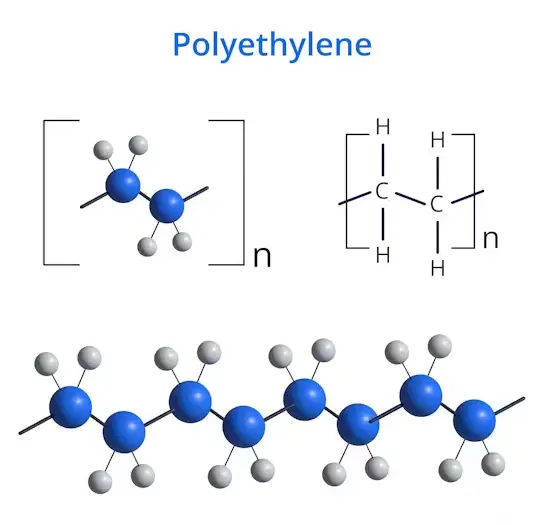
LDPE (low-density PE) is ductile and obviously low in density, and that’s why it’s popular for items like shopping bags, disposable packaging, and transparent food containers. We’ve put together a whole guide on low-density polyethylene if you’d like to find out more.
MDPE (medium-density PE) is used in things like gas pipes, shrink film, and carrier bags because of its medium density.
HDPE (high-density PE) is way more robust than the other types, and that makes it a perfect fit for things like snowboards, sewer piping, boat hulls, and folding chairs. Our guide on high-density polyethylene provides much more detail on this.
UHMWPE (ultra-high-molecular-weight PE), though not much denser than HDPE, is more resistant to abrasion because of its huge polymer chains. That’s why you’ll often come across this plastic in bearings, artificial ice skating rinks, and even hip implants (it has low friction while remaining rather dense).
Often referred to as Styrofoam, polystyrene can be solid and foamed. You’ll come across it in day-to-day items like egg cartons, disposable dinnerware, and drinking cups, and that’s mainly due to the fact it’s yet another type of plastic that’s cheap and easy to produce. Here’s a not-so-fun fact to remember, though: it’s extremely combustible and releases toxic chemicals when heated.
Acrylic is used all the time in optical products and gadgets because it’s relatively easy to produce and work with, as well as transparent, lightweight, and resistant to breakage. Sheets of it are also used for mirrors and plexiglass. PMMA is very popular because it has some unique characteristics, one of them being that it’s resilient against projectiles. What’s more, it resists UV rays and static electricity, and is compatible with bright dyes. As a bonus, it’s over fifteen times more impact-resistant than glass and polycarbonate sheeting combined. You can visit our guide on PMMA for more information.
Polycarbonate is strong, stable, and transparent; hence it’s a favorite when it comes to engineering purposes. One of its most impressive features is that its strength-to-weight ratio is 250 times better than steel’s, and it’s as clear as glass. That’s tough to beat. Transparent sheets of this stuff can be 30 times stronger than acrylic and surprisingly easy to work with. They’re also not difficult to mold or form (thermo-form or cold-form). Another characteristic of PC that many of Fsproto’s customers love is the fact that this material can be cut right away without the need to be pre-formed and manufactured. Police riot gear, greenhouses, CDs, and sunglasses are just some common things often made using polycarbonate. We have a guide on it if you’d like to learn more. This image shows a 3D-printed sample using polycarbonate: